icon

Call Now

86-755-26508999

icon

Email

tilo@3nh.com

icon

Time

8:00 AM - 5:30 PM (GMT+8)

Message

Consultation

About Us

3nh specializes in high-precision color measurement instruments, including colorimeters, spectrophotometers, and haze meters, serving industries like textiles, plastics, and coatings. With innovative R&D and global reach, we deliver reliable solutions for color management and quality control, trusted by customers in over 80 countries.

Products

Products Frequently Ask Questions

Record the L*a*b values of the sample and the reference with a calibrated spectrophotometer or colorimeter. Compute the difference in the color by use of ΔE. The lower the Delta E, the more accurate the result. The difference in energy, ΔE < 1, is generally assumed to be invisible to the eye.


A colorimeter sends light through a solution and measures the amount that is absorbed. It computes the absorbance by comparing the intensity of light before and after passing through. The greater the concentration of the color, the greater is the absorption of the light. It is also possible to quantify the color of the solution.


Gloss is a broad term to describe the reflectivity of a surface. Whereas high gloss is a specific term that has the highest reflectance (usually more than 70 GU). High gloss finishes are shiny, mirror-like, and exhibit more surface blemishes than lower gloss finishes.


Yes, we can offer Spectrodensitometer quality certification issued by our lab free of charge, or issued by third-party international inspection Organizations with extra charge, please contact us for confirmation.

Usually you will find haze and transmittance standards of ASTM D1003, ISO 13468, & JIS K7105.


When detecting color differences, the first factors to consider when selecting a light source include its stability, directionality, lifespan, and the effectiveness of the ultimately obtained spectral curve. The illuminant of a colorimeter is a fixed bulb, such as a tungsten lamp,LED light or a long-life xenon lamp. However, for the same color sample, the results displayed by the instrument vary under different light sources. This is because different light sources cause different absorption and reflection of light on the sample, leading to differences in how both the human eye and the instrument perceive the color. 

In general, the D65 light source is used in the application of coil steel inks for construction. The D65 light source is equivalent to average daylight. Most coil steel inks for construction are used outdoors, and sunlight is regarded as the standard light source in outdoor environments. For household appliance coil steel inks, due to their usage characteristics, they are mostly used indoors. Therefore, the A standard light source is adopted for color measurement of samples based on indoor lighting conditions. The A light source is a carefully specified tungsten light source. Other light sources, such as fluorescent light sources, can be used in many types of applications. For example, some textile factories use fluorescent light sources. Therefore, a reasonable light source should be selected as the mutually recognized measurement method based on actual usage conditions and user requirements. Once agreed upon by both parties, color measurement must be conducted under the same conditions. This helps reduce unnecessary systematic errors and human errors, achieving the optimal consistency in color measurement. 

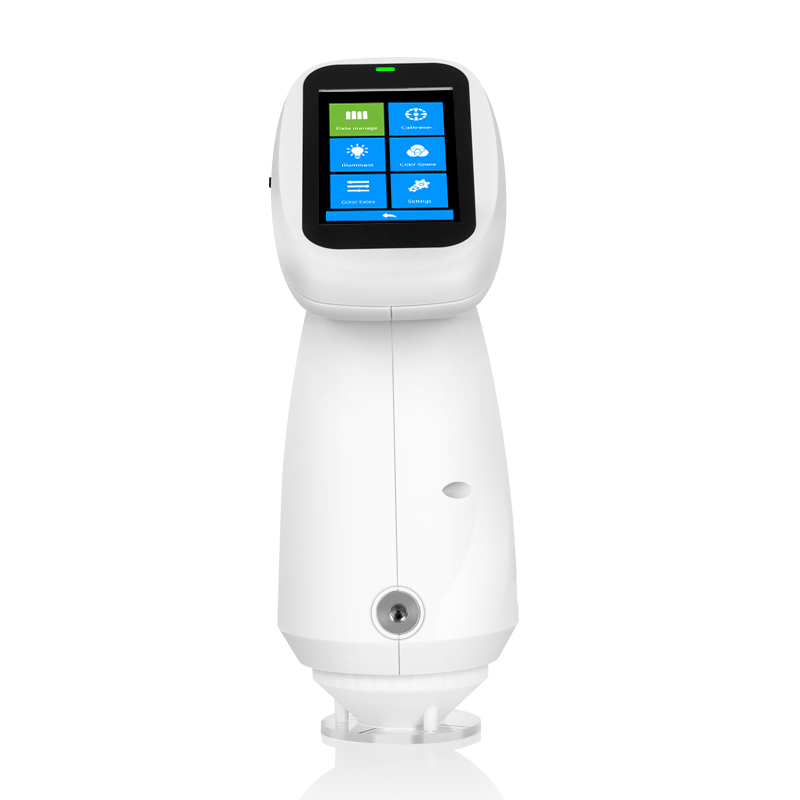
The 3nh high-precision spectrophotometric colorimeter adopts a combined LED light source with long lifespan and low power consumption, which includes UV (ultraviolet) and UV-excluded options. This design can meet the color difference detection needs of different users and supports the selection of multiple light source modes.

The CCC is much like the CAC yet it frequently has advanced programmable lighting, sophisticated electronic control systems that allow for light source switching, and advanced visual testing.


Take into account the measurement range, type of samples, needed precision, any relevant standards, and your industry.


In the study of chemical reactions, calorimetry deals with changes in heat (energy and enthalpy). Spectrophotometry is the measurement of the light absorbance or light transmittance to determine the concentration or color of a solution. The first one monitors the thermal processes, whereas the second one addresses the aspects of light and color.


Compared to an analog model, digital gauges not only provide more accuracy, but also allow for greater repeatability and are easier to work with. Advanced digital gauges allow for features such as data storage and automatic calibration and statistical analysis. For these reasons, digital gauges are the preferred choice for professional applications.